East Timor has a history of human occupation that begins around approximately 40000-20000 years before Christ. At this time, individuals of Vedo-Australóide type came and established themselves in East Timor, forming the initial populations. Later, in 3000 BC and 2500 BC, the second and third waves of occupation occurred, respectively by the Proto-Melanesian and Malaysian. Over time, many occupations by more or less distant people happened, which gave new unique features to the people of East Timor. But during these events there were no major cases of mixing between populations, which may be explained by the existence of various physical barriers. The lack of population mixing may explain the existence of a variety of cultures and languages. But despite this variety, the social structure of all populations was very similar.
More recently, in 1515 aC, the first Portuguese settlers reached enclave of Oecussi. The occupation remained until 1975, but the territorial and economic development was almost nil over the last 460 years. Governance based on a system supported by the local social structure, and the cultures and traditions have remained virtually unchanged during the Portuguese occupation. During the Second World War (1942-45), the Japanese invaded the territory, leaving a trail of misery and destruction. It was after the withdrawal of the Japanese that the relationship with Portugal was narrowed in an effort to support and recovery.
But with the Revolution of 25 April 1974 inPortugal and the fall of colonialism, East Timor had the opportunity to form the first political party. On 28 November 1975 the independence was declared and the Democratic Republic of Timor-Leste (RDTL) was created. On 7 December 1975, RDTL was invaded by Indonesian troops. This new period of occupation led to the rapid economic development due the large investments made by Indonesia. But this was also a time of great repression and several massacres. Governance was based on the power and the repression of local social structure.
In 1991 the turning-point happened. The movement of resistance was increasing strength until September 1999 when a referendum gives the independence to East Timor. After a transition period in the custody of the Security Council of the United Nations, the first free elections occurred and a new constitution was created on 24 March 2002. The May 20, 2002 was created the most recent democratic world.
Geography and description of the administrative territory
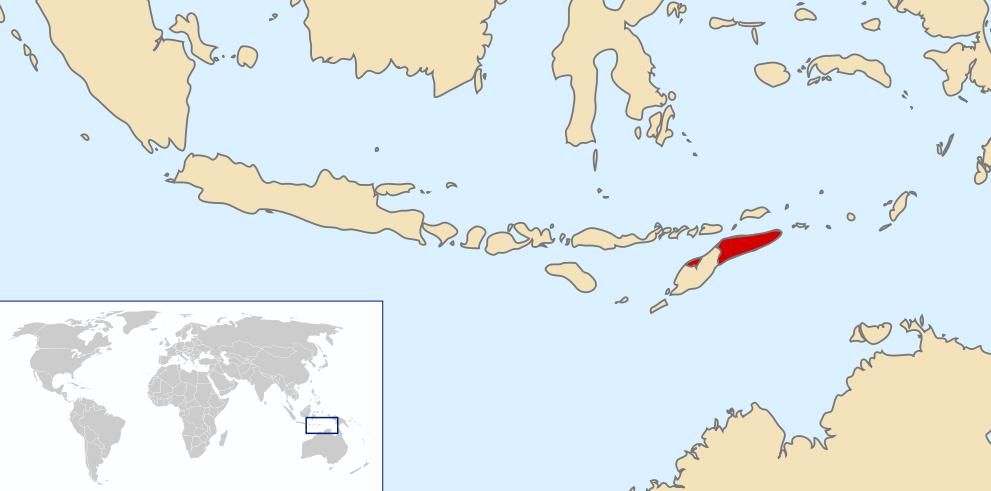
The island of Timor belongs to the Malaysian archipelago, which is located in Southeast Asia. Belongs to the Lesser Sunda Islands and it is the largest and located further east. At North are located the Straits of Ombai and Wetar that separates the island of Timor from the Republic of Indonesia. Still further north are countries like the Philippines, Malaysia, China and Japan. At South is the Sea of Timor which separates the island of Timor and Australia by approximately 600km.
Figure 1: Map of geographical location of East Timor.
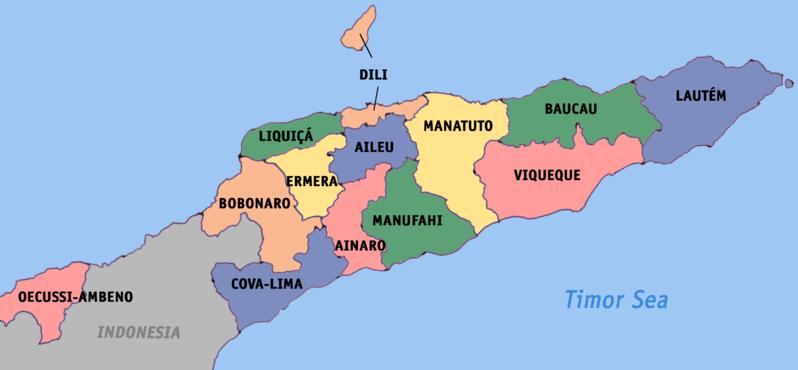
East Timor is about 15000km2. Of these, about 14,000 correspond to the eastern part of Timor. The remaining territory is distributed the following way: 815km2 on the enclave of Oecussi (in the western part of TimorIsland), 141km2 to the island of Ataúro (north of Dili) and 11 km2 to the small island Jaco (the area east of the country). In an administrative level, East Timor is divided into thirteen districts (Figure 2): Lautem Baucau
Aileu Manufahi Liquiçá Ermera Ainaro Viqueque Manatuto Dili Bobonaro Cova-Lima Oecussi-Ambeno
Figure 2: Map of the thirteen districts in which East Timor is divided.
The districts are formed by 65 subdistricts, 443 sucos and 2336 cities, towns and villages.
It is a very mountainous country with the highest point the Ramelau mountain whit approximately about 3000m high. The most flat areas are located near the coastline. This morphology creates distinct climates and a great diversity of fauna and flora. This also led to the emergence of a variety of crops, in particular due the isolation of populations from the waves of immigration.
Population
According to the census conducted in 2004, there are 923,198 people in East Timor. Although it represents about one tenth of the Portuguese population, it is a very rich ethnic and cultural population. There are dozens of groups who speak over 30 dialects. These represent the legacy of waves of immigration. However, the official languages of East Timor are Tetum and Portuguese.
Given the wide ethnic diversity and all the history of migrations, East Timor is an area of great interest to study at the level of human genetic variability.